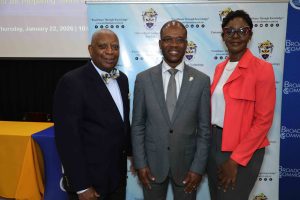
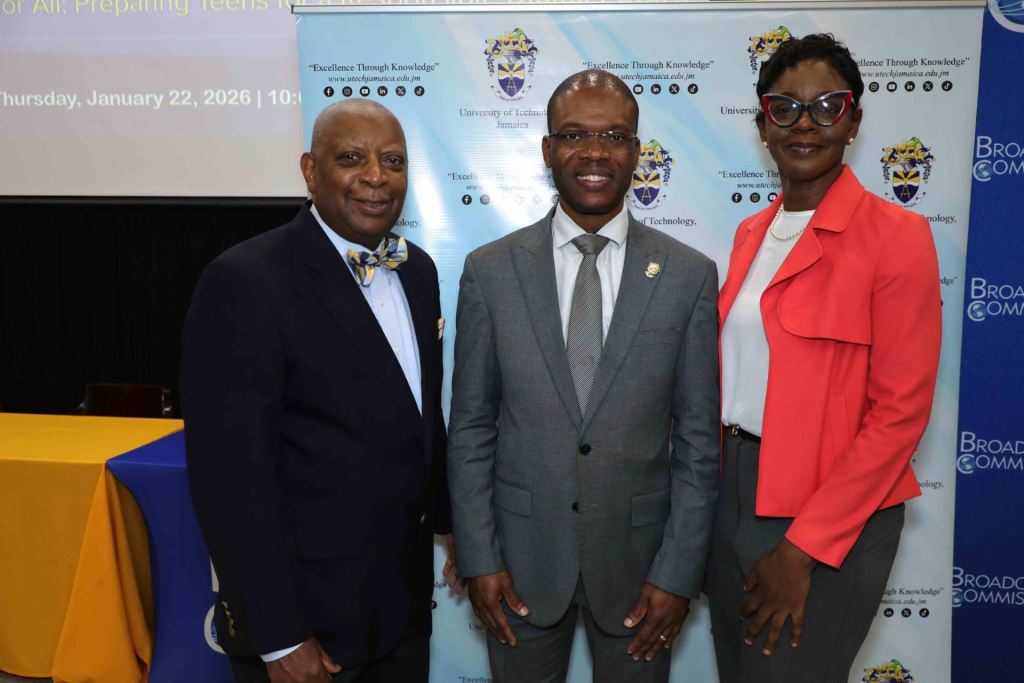
Dr. Kevin Brown (centre), President, University of Technology, Jamaica shares a photo with Researchers Professor Paul Golding (left), Professor of Information Systems in the College of Business and Management and Ms. Camille Jackson (right), Lecturer, College of Business and Management and Researcher.
The University of Technology Jamaica, in partnership with the Broadcasting Commission of Jamaica, launched the National Teens and Technology Report 2025: Digital Literacy for All – Preparing Teens for a Responsible Digital Future on January 22, 2026, at Lecture Theatre 50, Shared Facilities Building, UTech, Jamaica Papine Campus.
The groundbreaking research which was funded with over one million dollars from the university’s Research Development Fund (RDF), with co-funding of $750,000 from the Broadcasting Commission of Jamaica, (BCJ) was led by Professor Paul Golding, Professor of Information Systems, College of Business and Management (COBAM), and Ms. Camille Jackson, Lecturer (COBAM). The national report highlights key findings on technology use among Jamaican teenagers. For the first time, it also includes data and insights on Deaf and Blind students, underscoring an inclusive approach to digital literacy.
Dr. Kevin Brown, President, UTech, Jamaica, expressed gratitude to the Broadcasting Commission of Jamaica for its partnership and support of the research, as well as to the lead researchers for championing the study. He noted that the research provides critical insight into how the digital age is shaping younger generations, particularly amid the rapid advancement of artificial intelligence and its impact on cognitive abilities. Addressing the growing challenges educators face in assessing students in an evolving technological and AI-driven landscape, Dr. Brown stated, “We are operating in a post-pandemic AI driven world where the evolution of technology is unprecedented. Teenagers are now at the heart of this.” He also reaffirmed UTech, Jamaica’s support for the disabled community, noting, “you have a place at Jamaica’s national STEM university.”
In providing an overview of the study, Ms. Camille Jackson explained that the research employed an exploratory sequential mixed-methods design to examine how deaf, blind, and non-disabled teens engage with technology. She stated, “the study begins with a quantitative phase where data was collected using a survey instrument. The data was analyzed, and we identified patterns or trends from the responses. These findings are used to guide the second phase which is the qualitative phase where we used a focus group to provide a deeper understanding of our findings. All in an effort to add depth and rich details to our study.”
The research focused on three groups: deaf, blind, and non-disabled teens between the ages of 13 and 19, all enrolled in high school. Despite differences in ability, the findings revealed shared aspirations among participants.
Ms. Jackson noted that “92% of them, looking at all three sets of students, want to have a good career, 91% want to be a good parent, 93% of them want to own a home, 85% of them think that helping others is an honorable trait.” Her remarks underscored the strong alignment in life goals across all three groups.
However, while aspirations were similar, the study identified notable disparities in device access and privacy. Professor Paul Golding emphasized differences in both ownership and usage, particularly among deaf students. He pointed out that “for the deaf students you see they use less devices” and stressed that “this ownership item, is important, deaf students have more shared device than blind and non-disabled students.”
He further explained the privacy implications of shared technology, stating, “What that speaks to is the level of privacy that teens have. If you share a phone with somebody else, it means that you are sharing whatever you are doing on that device. And teens are not very comfortable with it. They want to have their privacy.”
Focus group findings revealed that 95% of teens have access to digital devices, primarily mobile phones, with smartphones emerging as the dominant choice. Smartphone ownership was reported by 94% of non-disabled students. In contrast, only 54% of deaf students owned a smartphone and were more likely to share devices than both blind and non-disabled peers, indicating greater privacy challenges.
Blind students were found to rely largely on screen-reading software and additional assistance, which similarly limits their privacy.
Regarding AI usage and its impact on teen creativity, the research found that 38% of deaf teens, 50% of blind teens, and 65% of non-disabled teens believe it increases their creativity. Another concern highlighted was AI’s effect on critical thinking. Findings indicated that 58% of non-disabled teens, 38% of blind teens, and 57% of deaf teens reported that AI use has improved their critical thinking skills.
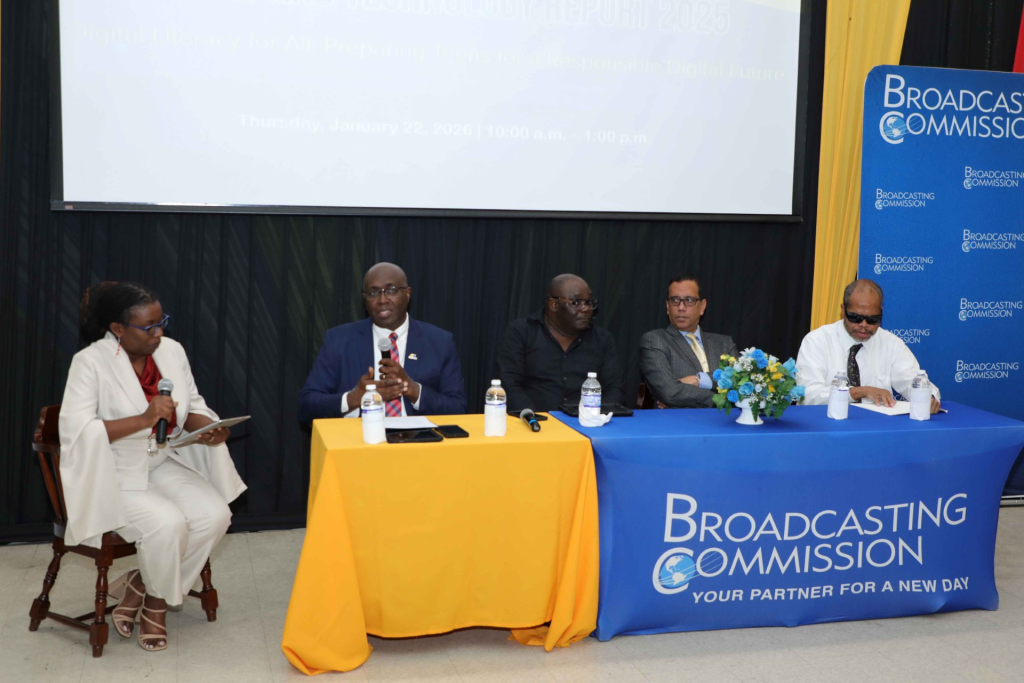
From left: Dr. Lisa Facey-Shaw, Associate Professor, School of Computing and Information Technology, Mr. Gary Allen CO, JP; Group Senior Executive for Cooperate and External Affairs, RJR Gleaner Communications Group and Chairman of the RG Cares Foundation, Mr. Cordel Green, Attorney-at-law and Executive Director, Broadcasting Commission-Jamaica Dr. Eduardo Ali, Pro-Registrar and Deputy Chief Executive Officer, Caribbean Examination Council and Mr. Vivian Blake, Education Officer for Braille Operations, Special Educations Unit, Ministry of Education, Skills, Youth and Information.
Following the research presentation, a panel discussion examined the findings presented in the study. The discussion was moderated by Dr. Lisa Facey-Shaw, Associate Professor in the School of Computing and Information Technology at the University of Technology, Jamaica. Panelists were Dr. Eduardo Ali, Pro-Registrar and Deputy Chief Executive Officer or the Caribbean Examination Council; Mr. Cordel Green, Attorney-at-law and Executive Director of Broadcasting Commission-Jamaica; Mr. Gary Allen CO, JP, Group Senior Executive for Cooperate and External Affairs at the RJR Gleaner Communications Group and Chairman of the RG Cares Foundation; and Vivian Blake, Education Officer for Braille Operations in the Special Educations Unit of the Ministry of Education, Skills, Youth and Information.
In addressing the broader implications of technological change, Mr. Gary Allen highlighted the rapid and ongoing evolution of technology. He emphasized that organizations must continuously adapt to remain relevant, stressing the importance of using diverse formats to effectively reach audiences in an increasingly digital environment.
Building on this point, Mr. Vivian Blake pointed to practical efforts already underway to improve accessibility. He referenced existing programmes that support deaf individuals, including the use of artificial intelligence to transcribe speech into text through captioning tools.
Meanwhile, Mr. Ali underscored regional efforts to integrate technology into education systems. He noted that the Caribbean Examination Council (CXC) is actively exploring ways to leverage technology to enhance accessibility. He explained that CXC has worked with a digital-skills working group established by CARICOM in 2022. The group examined the evolving digital landscape across the Caribbean and assesses how digital data and technologies are being integrated with the critical and fundamental skills of the region’s teens.

Students of the Lister Mair Gilby High School for the Deaf performing a dance presentation during the launch event.
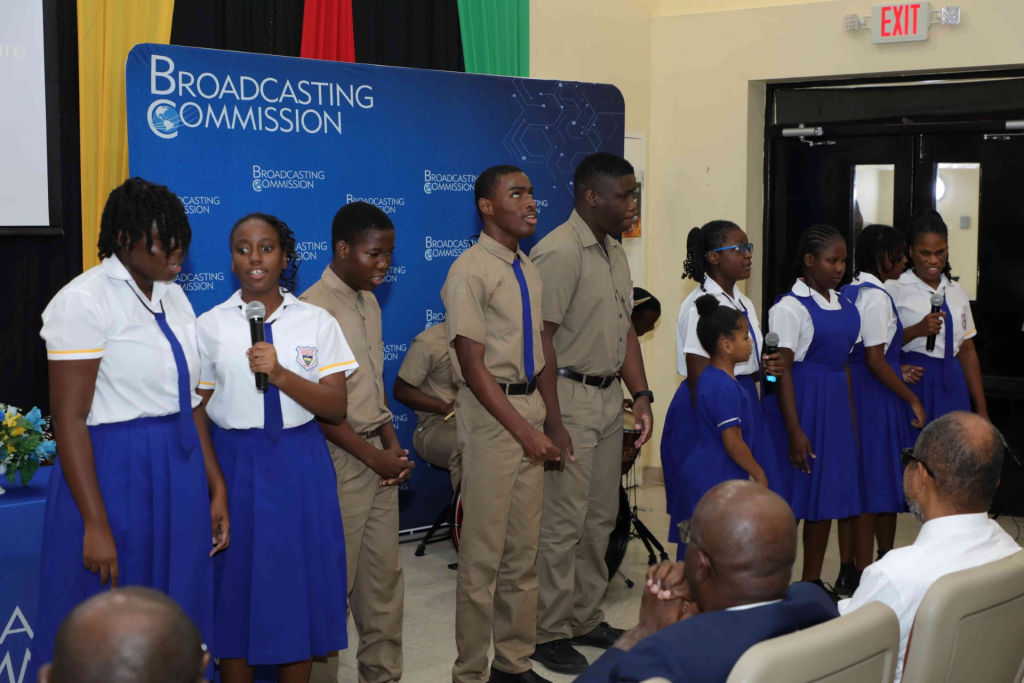
Students of the Salvation Army School for the Blind and Visually Impaired delivering a well received musical performance.
END.
Contact:
Michelle Beckford (Mrs.)
Corporate Communications Manager
University of Technology, Jamaica
Telephone: (876) 970-5299
Email: mbeckford@utech.edu.jm