

The University of Technology, Jamaica (UTech, Ja), in collaboration with the Office of the Information Commissioner (OIC), led the nation’s observance of International Data Privacy Day with the staging of the 2nd Annual International Data Privacy Conference on January 28, 2026.
The event was held at the Alfred Sangster Auditorium, UTech, Jamaica, Papine Campus under the theme, “Your Privacy Programme and You: Managing Privacy in the Age of AI and Digital Mistrust.”
The joint initiative featured addresses from industry experts and panel discussions on topics ranging from safeguards for data systems to organizational privacy management and global privacy policies in modern digital environments. Through the convening of thought leaders from government, academia, industry, and civil society, the initiative also aimed to advance national awareness and compliance under the Data Protection Act 2020.
A Governance and Ethical Imperative
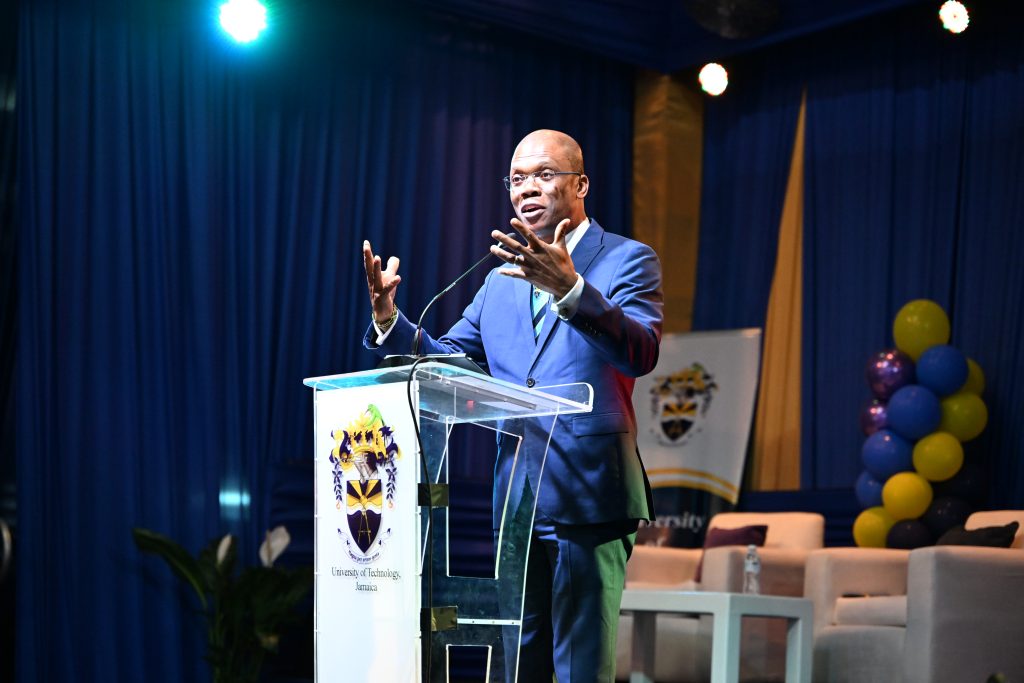
In his welcome remarks, Dr. Kevin Brown, President, UTech, Jamaica, stated that data privacy has become a governance and ethical imperative. “Artificial Intelligence, automation and data-driven technologies are rapidly reshaping our societies, economies, and institutions,” stated Dr. Brown. “In this environment,” “data privacy is no longer purely a technical or legal consideration: it is a governance imperative and the foundation of ethical, responsible innovation.”
Underscoring the critical responsibility of educational institutions in safeguarding sensitive personal data, Dr. Brown reaffirmed UTech, Jamaica’s leadership in capacity-building. “We signed a Memorandum of Understanding with Privacy Ref earlier this year to establish and deliver the Data Privacy and Protection short course through our UTechOpen: School of Lifelong Learning and Professional Development.” He also noted other key milestones, including the University’s 2023 partnership with e-Learning Jamaica to train the first cohort of 100 Data Protection Officers within the education sector, as well as ongoing undergraduate, graduate, and professional development programmes that support Jamaica’s digital and cybersecurity workforce.
Empowering Privacy Champions

Miss Celia Barclay, Information Commissioner, noted that privacy programme frameworks must be grounded in accountability, ethics, and respect for individuals’ rights. “Innovation, digital transformation, and national development must happen with respect for human dignity and protection of privacy, not at the cost of them,” Miss Barclay warned. She added that privacy management in today’s society requires intention, structure, leadership, awareness and full participation. Miss Barclay shared that the OIC embarked on a series of national sensitization initiatives, including school tours, which sought to build awareness among youth regarding data rights and privacy. The regulatory agency also launched a publication, the “Privacy Champions” student companion workbook, which is designed to foster early awareness and responsible digital citizenship.
A Pre-requisite to Sustainable Progress

The conference also featured remarks from Dr. the Hon. Andrew Wheatley, Minister with Responsibility for Science, Technology and Special Projects in the Office of the Prime Minister. Dr. Wheatley underscored the national importance of data privacy in safeguarding citizens against emerging threats such as AI-enabled fraud, identity theft, deepfakes, and cybercrime. He noted that modern privacy programmes must be “proactive…risk-based and embedded across organisational culture.” While acknowledging that innovation is necessary for national development, Dr. Wheatley stated that privacy programmess must evolve alongside national digital initiatives. He reaffirmed the government’s commitment to supporting the Office of the Information Commissioner and academia in monitoring compliance with data privacy legislation and strengthening public awareness.
Historical Parallels Shaping Modern Data Privacy

Drawing on historical parallels, Mr. J. Trevor Hughes, President and Chief Executive Officer, International Association of Privacy Professionals (IAPP), in his keynote address, conveyed to the audience how safety, trust and governance have informed societies’ adaptation to privacy frameworks.

His presentation examined five years of disruptive innovation between 1886 and 1891 when electricity, automobiles and photography reshaped society. Recounting how the introduction of the Kodak camera sparked initial global debates about privacy, Mr. Hughes noted that this ultimately led to the foundational legal concept of the “right to privacy” as articulated by the late United States Supreme Court lawyer, Louis Brandeis and British barrister and Member of Parliament, Samuel Warren.
The keynote speaker also pointed to moments of uncertainty accompanying the invention of electricity and automobiles. He stated that public trust was not gained until long after safety, standards, and governance were built into those technologies. Hughes emphasized that history informs us that effective data privacy management in today’s AI-driven era requires innovation and policy that evolve at an equal pace. “Whenever technology changes the terms of the social contract, the law must evolve,” said Hughes. “But the law is always a lagging response. That means organisations cannot wait for regulation to act—they must lead.” He assured innovators in the audience that trust and safety do not slow technology, but rather, accelerate it.
Illustrating this point, Hughes referenced Bertha Benz’s invention of automotive brakes and Elisha Otis’s elevator safety systems. He explained that safeguards enabled those technologies to scale and gain public acceptance. “We won’t use technology if we don’t trust it,” Hughes said. “Brakes didn’t slow cars down—they made it possible for them to go faster,” he noted.
With regards to modern systems, Hughes argued that artificial intelligence, though “more profound than electricity,” risks facing similar public fear and resistance as with earlier technologies if robust governance, professional standards, and accountability mechanisms are not in place. He challenged organisations to embed privacy, trust, and accountability into emerging technologies proactively and desist from playing legislative ‘catch-up.’
Official Launch of UTech, Ja and Privacy Ref Training Programme

Participating in the occasion are Dr. Nadine Barrett Maitland, Senior Lecturer, School of Computing and Information Technology, Dannille Webster-Dolphy, Legal Officer (Data Protection), Dr. Sophia McIntosh, Head, UTechOpen, Professor Shermaine Barrett, Deputy President and Provost and Mr. Andray Lawrence, Data Protection Officer, UIech, Jamaica.
During the conference, the University of Technology, Jamaica and Privacy Ref officially launched their collaborative Data Privacy and Protection training initiative.
The training partnership follows the signing of a Memorandum of Understanding on January 5, 2026 between Privacy Ref and the university, through its UTechOpen (School of Lifelong Learning and Professional Development). Under the agreement, UTech, Jamaica and Privacy Ref will design and deliver certified data privacy-related short courses to individuals. The first delivery is scheduled for April 1 and is available to the public.
Dr. Sophia McIntosh, Head, UTechOpen, noted, “People need to develop competency in data protection because reputational damage is at risk,” and therefore, “we must upskill and reskill the people that we employ.” Mr. Bob Siegel, Founder and President of Privacy Ref, stated that the course is designed to provide participants with a practical and comprehensive introduction to data protection and privacy management. He stated that the six-week programme intends to equip persons with sound knowledge of legal and operational considerations for privacy management in the Jamaican and global contexts. The course also centres on implementing an effective privacy programme within organisations.
Mr. Andray Lawrence, Data Protection Officer and Dr. Nadine Maitland-Barrett, Senior Lecturer, School of Computing and Information Technology, shared that UTech, Jamaica also provides Data Privacy Management Consultancy to support organisations’ efforts to become compliant with the Data Protection Act 2020.
Photo Highlights





– END –
Contact:
Michelle Beckford (Mrs.)
Corporate Communications Manager
Corporate Communications Unit
University of Technology, Jamaica
237 Old Hope Road, Kingston 6
Tel: (876) 970-5299 Ext. 2299
Cell: (876) 818-5893
Email: mbeckford@utech.edu.jm